Showing posts with label films. Show all posts

Tuesday, October 11, 2022

DARK CITY--AN INFORMATION COMPANION--CHAPTER 1

Dark City: The Lost World of Film Noir, by Eddie Muller (Revised and Expanded Edition, 2021, Running Press, 448p.--E-BOOK VERSION)

EACH BLOG POST REPRESENTS A CHAPTER IN THE BOOK. 

FILM ANNOTATIONS ARE IN THE ORDER OF THEIR DISCUSSION IN THE BOOK. 

CLICK ON ANY T.O.C. LINK (COLOR AND UNDERLINE) TO LINK TO THE ANNOTATIONS FOR THAT CHAPTER. 

CHAPTERS THAT HAVE LINKS HAVE BEEN COMPLETED OR ARE IN PROCESS. 

CHAPTERS IN LARGE TYPE WITHOUT LINKS ARE THE CHAPTER YOU ARE LOOKING AT. 

CHAPTERS THAT ARE NOT LINKED ARE CHAPTERS THAT HAVE NOT YET BEEN ANNOTATED

==============================

TABLE OF CONTENTS

INTRODUCTION 

Chapter 1: "Welcome to Dark City: Travelers advisory for a safer Journey"


C 6: "Shamus Flats: Lost someone? Gumshoes for hire"

C 7: "Vixenville: Fiefdom of the femme fatale"

C 8: "Blind Alley: Crossroads of coincidence and Fate"

C 9: "The Psych Ward: Where vexed veterans are quarantined"

C 10: "Knockover Square: Deluxe district of heists and holdups"

C 11: "Losers Lane: Street of sorry psychopaths"

C 12: "The Big House:  Last stop on a wayward course"

C 13: "Thieves Highway: The risky road out of town"

C 14: "The Stage Door: Enjoy a show... before it's too late

==============================

Chapter 1: "Welcome to Dark City: Travelers advisory for a safer Journey"

*=Blacklisted. For further information see the Introduction.
**=Trailer Available at Internet Movie Database (IMDb).

For other source notes, see the Introduction.

1.  City That Never Sleeps (Republic, 1953) (Director: John H. Auer) (Archival Spaces--Jan Christopher Horak)

Top Billed male star: Gig Young (Wikipedia)

Note: Gig Young's life was, in some ways, like a Film Noir. Only the ending was worse, much worse.

Top Billed female star: Mala Powers (London Guardian Obituary--Ronald Bergan)

Note: Cinematographer John L. Russell (WIK) has 45 AFI credits in a 34 year career (1933-1967). He earned one Academy Award nomination: 1960: Psycho, Alfred Hitchcock.

Note: Composer R. Dale Butts (Onlive Archive of California) has 88 AFI credits in a career that spanned 13 years (1944-1957) as a workhorse for Republic. He earned one Academy Award Nomination: 1945, Flame of the Barbary Coast, Joseph Kane.

Note: Muller begins the book with a prototypical Noir. A B Poverty Row film, set in a city, with a lot of darkness, with two of the more weird character parts you will see, and a set piece ending that will leave a mark.  

Note: This was Tom Poston's (WIK) debut film.


Wikipedia (WIK)

---

2. Cry of the City (Fox, 1948) (Robert Siodmak(Senses of Cinema--Chris Justice) 

Note: Robert Siodmak has been called the quintessential Noir Director. Depending on the source, he directed 11 or 12 Noirs. In 1946, three of his films (The Spiral Staircase, The Killers, and Dark Mirror, in total earned 6 Academy Award nominations. 


---

3. The Long Night (RKO, 1947)  (Anatole Litvak)

AFI 


---
 
4. Dial 1119 (MGM, 1950) (Gerald Mayer) 


---

5. Union Station (Paramount, 1950) (Rudolph Maté) (WIK) 

Maté began his career as a cinematographer and is most well known for The Passion of Joan of Arc (Carl Theodor Dreyer, 1928) and Vampyr (Carl Theodor Dreyer, 1932). He has 78 Cinematography credits (Internet Encyclopedia of Cinematographers [IEC] as well as 26 AFI Director credits in a career that spanned 43 years (1920-1963). He earned 5 Academy Award nominations for Cinematography and also directed three films where he also had a role as Cinematographer. 

Cinematographer Daniel L. Fapp (Internet Encyclopedia of Cinematographers [IEC])  has 91 AFI credits in a career spanning 40 years (1929-1969). He earned 8 Academy Award nominations and won once (1961, West Side Story, Robert Wise; Jerome Robbins). 


---

6. Edge of Doom (RKO, 1950) (Mark Robson/Charles Vidor)


---

7. The Sleeping City (Universal, 1951) (George Sherman)

AFI 


---

8. Frightened City (The Killer that Stalked New York) (Columbia, 1951) (Earl McEvoy)


---

9. Panic in the Streets (Fox, 1950) (Elia Kazan)


---

10. Fourteen Hours (Fox, 1951) (Henry Hathaway)


==============================

Dark City: The Lost World of Film Noir, by Eddie Muller (Revised and Expanded Edition, 2021, Running Press, 448p.--E-BOOK VERSION)

EACH BLOG POST REPRESENTS A CHAPTER IN THE BOOK. 

FILM ANNOTATIONS ARE IN THE ORDER OF THEIR DISCUSSION IN THE BOOK. 

CLICK ON ANY T.O.C. LINK (COLOR AND UNDERLINE) TO LINK TO THE ANNOTATIONS FOR THAT CHAPTER. 

CHAPTERS THAT HAVE LINKS HAVE BEEN COMPLETED OR ARE IN PROCESS. 

CHAPTERS IN LARGE TYPE WITHOUT LINKS ARE THE CHAPTER YOU ARE LOOKING AT. 

CHAPTERS THAT ARE NOT LINKED ARE CHAPTERS THAT HAVE NOT YET BEEN ANNOTATED

==============================

TABLE OF CONTENTS

INTRODUCTION 

Chapter 1: "Welcome to Dark City: Travelers advisory for a safer Journey"


C 6: "Shamus Flats: Lost someone? Gumshoes for hire"

C 7: "Vixenville: Fiefdom of the femme fatale"

C 8: "Blind Alley: Crossroads of coincidence and Fate"

C 9: "The Psych Ward: Where vexed veterans are quarantined"

C 10: "Knockover Square: Deluxe district of heists and holdups"

C 11: "Losers Lane: Street of sorry psychopaths"

C 12: "The Big House:  Last stop on a wayward course"

C 13: "Thieves Highway: The risky road out of town"

C 14: "The Stage Door: Enjoy a show... before it's too late

==============================

Friday, October 7, 2022

DARK CITY--AN INFORMATION COMPANION--INTRODUCTION

Dark City: The Lost World of Film Noir, by Eddie Muller (Revised and Expanded Edition, 2021, Running Press, 448p.--E-BOOK VERSION)

EACH BLOG POST REPRESENTS A CHAPTER IN THE BOOK. 

FILM ANNOTATIONS ARE IN THE ORDER OF THEIR DISCUSSION IN THE BOOK. 

CLICK ON ANY T.O.C. LINK (COLOR AND UNDERLINE) TO LINK TO THE ANNOTATIONS FOR THAT CHAPTER. 

CHAPTERS THAT HAVE LINKS HAVE BEEN COMPLETED OR ARE IN PROCESS. 

CHAPTERS IN LARGE TYPE WITHOUT LINKS ARE THE CHAPTER YOU ARE LOOKING AT. 

CHAPTERS THAT ARE NOT LINKED ARE CHAPTERS THAT HAVE NOT YET BEEN ANNOTATED

==============================

TABLE OF CONTENTS

 INTRODUCTION 


C 6: "Shamus Flats: Lost someone? Gumshoes for hire"

C 7: "Vixenville: Fiefdom of the femme fatale"

C 8: "Blind Alley: Crossroads of coincidence and Fate"

C 9: "The Psych Ward: Where vexed veterans are quarantined"

C 10: "Knockover Square: Deluxe district of heists and holdups"

C 11: "Losers Lane: Street of sorry psychopaths"

C 12: "The Big House:  Last stop on a wayward course"

C 13: "Thieves Highway: The risky road out of town"

C 14: "The Stage Door: Enjoy a show... before it's too late
==============================
I have been re-jiggering some of my information interests lately. Away from sports, and toward another long standing interest--film. My favorite films are silent films. My second favorite films are Films Noirs. It is to my second favorite films that this blog is aimed. This is a meta-site blog. There will be little to no analysis or opinion on my part. Far more knowledgeable people than I can be consulted on that. 

This project began when I acquired a well known Noir compendium: Dark City: The Lost World of Film Noir (revised and expanded edition) by Eddie Muller, AKA the Czar of Noir (Muller also organizes an annual Noir Film Festival, held in the Bay Area). More on him can be found at his website. It is not an academic treatment, rather an impressionistic tour of the various aspects of Noir as he sees them. It is a very interesting, educational, entertaining read. But the best part of it, for me, is an in chapter running filmography. It identifies hundreds of Noirs. (It is not exhaustive. See Michael F. Keaney's amazing Film Noir Guide: 745 Films of the Classic Era 1940-1959 for that. Keaney, also not an academic, has produced what has become a standard reference in the field, and his annotated bibliography alone-- although my copy is current only through the early 2000s--is more than worth the price.) 

These Noirs, in the context of their time, theme, and style, inspired me to put together this companion, which links every film to four sources of further information about it: 

4. Wikipedia (WIK)

At these sites you will be able to find exhaustive information about each film discussed in Dark City. In fact, you will be able to find anything you want to know about each film and then some. 

In addition, there will be links to more information (if available) about the following aspects of each film, in the below listed order: 

1.  Director
2.  Top Billed male star
3.  Top Billed female star
4.  Complete script
5.  Studio Press Book
6.  DVD/Blue Ray commentator track information
7. Synopsis and lengthy script quotations 
8.  Cinematographer
9.  Music Composer
10. Other interesting things about the film
11. Gross Revenue--actual and inflation adjusted  
12. ** will mark available Theatrical Trailers (coming attractions) at IMDb. The videos are usually 1 to 3 minutes in length and have a style of their own.

That is all that this blog will do. It will help you increase your enjoyment of Muller's wonderful book. It will serve as an introduction to whatever it is that Noir is in the context of Film (a much debated topic). What it will not do is link you to the actual films. Almost every film in the book is copyright protected. I will not link to sites that violate copyright. However, the above sources will give more than enough information to legally enjoy most, if not all of the films. 

And for those with budgets, if you have a library card at any public or academic library, and the film is not available at that library, you can (yourself or have your librarian do it for you), find the film at the world's largest library catalog: WorldCat (look the film up as a title). Then simply ask your local librarian to loan the film for you via Inter Library loan. They will acquire it from the  library that is geographically nearest your home. If your public library is too small to do this directly, they should have connections to a larger public library that can. Your Public Librarian will enjoy the chance to provide such a service, as it is not particularly well known outside the academic world. Since WorldCat is the largest catalog, it has the most items and is connected to the most libraries (public, academic, etc.). Which means that if a film is available via DVD, blue ray, or other formats, you will almost certainly be able to find it. (ADDED February 1, 2023).

Because of the sheer volume in the filmography, the links above are to chapter by chapter filmographies. That way you will be able to explore whatever aspects of Noir that are interest to you. All Table of Contents links will link to all other T.O.C. links. 

I will be uploading this blog as I go. So keep an eye on it for additions.

Note: A great place to start (although dated), is Annenberg Lerner's 10 part documentary: American Cinema (Particularly Chapter 7: Film Noir. About 60 minutes). Narrated by Richard Widmark (Crimreads.com--Zach Vasquez). (ADDED January 29, 2023).

Notes on selected sources and annotations.

*=Blacklisted--* means that the person was a victim of Blacklist begun by the US House Un-American Activities Committee (HUAC) as result of hearings held in the late 1940s.  

Career numbers, dates, and spans are based on American Film Institute (AFI) data. Different sources tend to have different numbers for various reasons. I have used AFI because it is an internally consistent source, easily enumerated.  

Note: Box Office Grosses, when available, are taken from Variety (1st week in January Issue). When they are not available from that source, they are taken (if available), from Wikipedia, who's contributors generally use the Historical Journal of Film, Radio, and Television; The William Shaefer Ledger.  Appendix 1, (1995) 15:sup1, P. 1-31, if not specifically stated otherwise. The different sources make comparing grosses between them impossible. I used the Variety source because it places the film gross in the context of other top grossing films for the year. In certain cases I will use other sources, which I will identify. For Comparisons to purchasing power today (2023) the source is Official Data Foundation (Ian Webster): PPT Figures are rounded to the closest million dollars.

Note: Title Screen shots for most of these films can be found at Filmsite.org, an amazing film compendium by Film Critic and Historian Tim Dirks. Simply click on the decade and then the year. Then "find in page" or scroll to the title of interest. Individual titles are arranged in alphabetical order.

==============================

Dark City: The Lost World of Film Noir, by Eddie Muller (Revised and Expanded Edition, 2021, Running Press, 448p.--E-BOOK VERSION)

EACH BLOG POST REPRESENTS A CHAPTER IN THE BOOK. 

FILM ANNOTATIONS ARE IN THE ORDER OF THEIR DISCUSSION IN THE BOOK. 

CLICK ON ANY T.O.C. LINK (COLOR AND UNDERLINE) TO LINK TO THE ANNOTATIONS FOR THAT CHAPTER. 

CHAPTERS THAT HAVE LINKS HAVE BEEN COMPLETED OR ARE IN PROCESS. 

CHAPTERS IN LARGE TYPE WITHOUT LINKS ARE THE CHAPTER YOU ARE LOOKING AT. 

CHAPTERS THAT ARE NOT LINKED ARE CHAPTERS THAT HAVE NOT YET BEEN ANNOTATED

TABLE OF CONTENTS

INTRODUCTION 


C 6: "Shamus Flats: Lost someone? Gumshoes for hire"

C 7: "Vixenville: Fiefdom of the femme fatale"

C 8: "Blind Alley: Crossroads of coincidence and Fate"

C 9: "The Psych Ward: Where vexed veterans are quarantined"

C 10: "Knockover Square: Deluxe district of heists and holdups"

C 11: "Losers Lane: Street of sorry psychopaths"

C 12: "The Big House:  Last stop on a wayward course"

C 13: "Thieves Highway: The risky road out of town"

C 14: "The Stage Door: Enjoy a show... before it's too late

==============================

Saturday, April 6, 2019

Paul Dukas, Walt Disney, Mickey Mouse, Dan Robbins, AND ME

Here begins a set of posts that are slightly autobiographical in nature. They have to do with how certain people, toys, games, films, books, devices, events, etc. have influenced my life. They will be in no chronological order, so you can jump into any of them at any time. As I am learning early in retirement, the clock and calendar are chains that lock us into an unnatural existence. They are essentially levers of power, used by the powerful, against the powerless.

But, as David Copperfield (much more on him in a later post, he had an enormous impact on my life) once famously said... (address updated January 15, 2021) and I don't think it can be said any better than that. So, I will begin at the beginning. I actually was born on a Friday, at 11 o'clock in the morning. I believe I probably began life just like David, but, though I was there, I don't remember.

In any event, one of my earliest memories is rocking in a rocking chair, listening to music on albums that my parents received through their membership in the Columbia Record Club. It was an attempt (successful, I think) to bring a little culture to the South Side of Chicago. Every month we would get a new album. One of the albums had a really evocative cover. I used to listen to it over and over. My mom would play it whenever I asked for it. I still hum it when I walk without a musical device implanted in my ear. It was Paul Dukas' Sorcerer's Apprentice. I thought the whole side of the album was that one piece. It turns out that SC was one of two tracks on side A, the other being Jaromir Weinberger's Schwanda: Polka and Fugue from his opera Schwanda the Bagpiper (for the music in context, scroll to near the end of the opera). On the other side of the record was Salome: Dance of the Seven Veils, by Richard (pronounced Reek Hard) Strauss and Franz Lizt's Les Preludes (which was the background for the Flash Gordon Conquers the Universe 1940 serial (link updated January 15, 2021), which I later watched on Saturday mornings (Flash Gordon also had an influence on my life--he made me, for one day, into a TV star--but that is for another AND ME post).  Probably one of the reasons I was so into FG (dont' laugh too hard, George Lucas was into him also--what else is Star Wars but Flash Gordon brought into the future?) was because I resonated with the Liszt music.

Parenthetically, It is the Liszt and Weinberger that I am much more drawn to now, and that I hum much more than the Dukas. But it was the Dukas that got me into film.

What was it about the Dukas music? Hmmm. I wonder. During my time as an undergrad at the University of Wisconsin-Madison, I found out that one of the theaters in town played a revival of the Disney Classic Fantasia every year. So one year I went out to see it. I settled back into my seat at the old Hilldale Theatre (long since demolished and replaced by an "art" cineplex). The hall darkened and the film began. Even though I had never seen it, I had a feeling I had seen it. I'm pretty sure Fantasia was the first film I ever saw.

The fact that the record came as part of a mail order subscription was serendipitous, I think. Something about the film really imprinted on me. Watch the Sorcerer segment here. This isn't a Youtube copyright violation. It is distributed by the Disney Company and is pristine. The animation is amazing. Imagine watching it on a 40 foot screen as a 5 or 6 year old, which must have been how I saw it on one of its revivals. It was 15 or so years old when I saw it.

Something about looking at the album cover while listening, about rocking in the chair, got me going, and it wasn't until much later that I realized all the music on that side of the album wasn't Dukas. That was my favorite album well into my 30s before I gave it up when CDs made albums obsolete. Who knew they would come back?

As to Sorcerer's Apprentice, it tells a story that resonates today, I think. About hubris, about overproduction, about rushing into technology without understanding the possible unintended consequences. There is a small segment of it, "Mickey's Dream Sequence", where he controls the Universe, and makes the stars blink on and off with the pointing of his finger, causes the weather to change, etc. That too resonates with me. We think we can do anything, right up until the moment we destroy ourselves, and possibly the planet with us. I hope our sorcerer comes back in time, like Mickey's did, but fear he won't. Anyway, it's more than a cartoon, A cautionary tale, perhaps. And, ironically, told to us by one of the most right wing reactionary capitalists in history. Did he know something we don't?

When I was a senior in college, I took a "blow off" class, Introduction to Film, taught by a now legendary professor named David Bordwell. I say "blow off" because I took it pass-fail and because at the time (in the early 1970s) film was not considered a real academic subject. It was usually the orphan child of either the English Department or, as in the case of UW, the Communication Arts Department. When I went "back to school" after age 60 (which, by law, any resident of the state can do as a "senior guest auditor", for free or a very nominal fee depending on the campus), the first thing I did was clean out the Comm. Arts Department's Film offerings--eight classes over 3 years (Film History 1890-1960; Film History 1960-Present; Documentary Film; Russian-Soviet-Russian Film; European Art Cinema; American Film History 1970-present; Film Noir; and German Film (through the German Department). That's 14 free films a class. Free. Film has grown up as a discipline in the last 40 years. It has its own language and theory now. And a lot of that has to do with David Bordwell. If you check out his site above, you'll begin to see the scope of his scholarship and vast knowledge of the field. Also his love of film. I looked at a blog piece he had done on Walt Disney because I remember him teaching Disney to us. You can read it here. Note from the first epigram that Sergei Eisenstein took Walt Disney very seriously. It was from Bordwell that I learned the scope and power of Disney's vision.

So that is how Paul Dukas, Walt Disney, and Mickey Mouse came into my life, Music, art, and film.

As an addendum to this piece, I found out today that Dan Robbins, the man who invented "paint by numbers", one of the big fads of the 1950s, had passed away at age 93. My mom, who recently passed away at age 97, did one of his paint by numbers. It was hung proudly in a conspicuous place in our houses in the 1950s and 1960s. Robbins tackled all sorts of subjects, and I was able to find the Paint by Number Museum. Would the great painting she did hang there? I had to search to find out. The key word was "nude." Presto. There it was. My mom. Nurse for nigh on half a century, mother and family woman, painted this and hung it for all to see.

Take a look. Would your mom paint such a picture? And hang it for all to see? A bit of Greewich Village on the South Side of Chicago.

Tuesday, January 8, 2019

Baseball--Opening Day--1931 and 1934--film highlights with real sound

I found two of the most amazing baseball highlight films I've ever seen and wanted to share them with you. They speak for themselves.

The highlights are both from Yankee Stadium--Opening Day, April 14, 1931, Yankees v Red Sox, and Opening Day (Yankees Home Opener) April 24, 1934, Yankees vs A's. They are sound films and that is what is so amazing about them. You will hear the voices of Babe Ruth, Joe McCarthy, Shano Collins (Red Sox Manager), and Connie Mack among others. You will hear the voices of Mayors Jimmy Walker and Fiorello Laguardia. You will hear the actual crack of the bat, along with crowd noises. You will see the pitching motions and batting stances of the time. You will not see outfield play, as the cameras couldn't cover it at the time. Mostly you will see a packed Yankee Stadium (70,000 in the 1931 game and about 40,000 according to the Brooklyn Eagle account--see below, in the 1934 game). This was the height of the Depression but you'd hardly know it based on these films. Note especially the bleacher crowd shot in the 1931 game. An integrated (if not by many) crowd.

April 14, 1931: Boston 3 at New York 6 (14 minutes, 21 seconds)
Wilcy Moore (who had pitched on 1927 Yankee juggernaut) v Red Ruffing

Babe Ruth would bat .373 with 46 HR, 162 RBI, 149 runs, 126 walks, and 51 strikeouts in 145 games. Not too shabby for a 37 year old. Yanks would finish 94-59, 2nd in the American League, 13.5 games behind the A's 107-45.

Box score and  play by play (Retrosheet.org)

Note especially the time of the game. They didn't mess around.

Game Story: Brooklyn Eagle, Apr. 15, 1931

April 24, 1934: Philadelphia 0 at New York 1 (17:52). (Note: this game is no longer available as of October 15, 2019). I will leave the rest of the story here, in the hopes that the game will be available again soon.

Johnny Marcum v Red Ruffing. This was Ruth's last year with the team. At age 40 he batted .288 with 22 HR, 84 RBI, 78 runs, 104 walks and 63 strikeouts in 125 games. Yanks would finish 94-60, 7 games behind the Tigers 101-53. Note: #6 on the A's is Jimmy Foxx.

Box score and play by play (Retrosheet.org)

Game story: Brooklyn Eagle, April 25, 1934

The provider is Guy Jones' Youtube site, which also contains an absolute treasure chest of old "slice of life" newsreel films going back to the 1890s (including some Lumiere Brothers films), some with live sound, some with added sound. The site is pretty amazing. I have not seen anything like it.

Wednesday, December 5, 2018

Berkeley and Pacific Film Archive: Fritz Lang and German Expressionist Film Festival

Fritz Lang and German Expressionist film, December 2018-February 2019

The Berkeley and Pacific Archive is running this magnificent program of mostly silent German films from the Weimar era.  Show times and details are available at the above address.

For those who cannot make it to the festival a poor substitute for it is provided below.  All available films are Youtube videos except the last one, which is a dailymotion.com video. It is unknown how long any of these videos will be available. All addresses worked at the time this post was added. If any do not, simply search youtube by author or title of the film. Most of the films are directed by Fritz Lang, but there are also films by Joe May, F.W. Murnau, Paul Wegener, and Robert Wiene.

The films are listed below in the order that they are shown in the program. All films have English subtitles, either built in or via closed captioning. Three of the films (M, Liliom, and The Testament of Dr. Mabuse), are sound films. This program is about as good a sampling of Weimar cinema in one place as any I've seen. If you are in or near the Bay Area, I cannot recommend it highly enough. If not, these videos are links to the best versions I could find. Watching them on a smart phone or even laptop, to say the least, does not do them justice. Hook your device to the largest screen you have available to get a flavor of what they really look like. Note that both Youtube and Dailymotion have an icon to expand the videos to full screen.

Click on "view details" for any of the films listed at the above program address for more information (including selected reviews) of these films.

Below the video links a brief bibliography of video and print works on German film in the Weimar period is provided. The best place to start is Cinema Europe: Part III--The Unchained Camera

Feedback is always welcome: jbsolock1@gmail.com.

Enjoy

--------------------------------

Unless otherwise specifically stated, Lang is the Director of these films.

=================================

Metropolis (2:30:11) (1927). CC should be underlined to get English subtitles. If not, click on it.

Added Dec. 30, 2018: Exposition: Kristin Thompson and David Bordwell: Observations on Film ArtMetropolis Unbound 

============================

The Cabinet of Dr. Caligari (1:14:22) (1920). ROBERT WIENE. This version has English subtitles built in. (Changed April 8, 2019)

Added Jan. 8, 2019: Review: Roger Ebert: The Great MoviesThe Cabinet of Dr. Caligari 

============================

The Last Laugh (1:30:14) (1924) F.W. MURNAU. No dialog. Some title cards. CC should be underlined to get English subtitles. If not, click on it.

Added Jan. 8, 2019: Review: Rahul Hameed: Senses of Cinema
Added Jan. 8, 2019: Video Review: (4:31) Richard Brody, New Yorker 

============================

Faust (1:55:41) (1926) F.W. MURNAU. Built in English subtitles. Best music.

Shorter version (1:46:27), HD. Built in English subtitles. Pedestrian music.

Added Jan. 8, 2019: Review: Philip French: Guardian
Added Jan. 8, 2019: Video Review: (4:04) Richard Brody: New Yorker 
============================

The Spiders, Pt. 1 and 2 (2:17:19) (1919, 1920). Built in English Subtitles.

Added Jan. 8, 2019: Review: Vincent Canby: New York Times

============================

Harakiri/Madam Butterfly (1:26:34) (1919). CC should be underlined to get Spanish subtitles. If not, click on it. Then click on settings (gear icon), subtitles--->Auto-Translate--->English.

Another version (59:50) (1919) CC should be underlined to get English subtitles. If not, click on it. Very much inferior in quality to the version above. Provided for those might have trouble with instructions to get to English subtitles above. Original version of this was removed by Youtube. This is the same version, from another source (changed April 8, 2019)

Added Jan. 8, 2019: Review: J.E. de Cockborne: A Cinema History

============================

The Golem (1:41:23) (1920) PAUL WEGENER. Built in English subtitles.

Better, longer version (2:00:22). German only subtitles.

Added Jan. 8, 2019: Review: Chris Justice: classichorror.com

============================

Destiny (Der Mude Todt) (1:38:15) (1921) CC should be underlined to get English subtitles. If not, click on it.

Added Jan. 8, Book chapter: Lotte Eisner: The Haunted Screen: Chapter 5: The Stylized Fantastic (P. 89-94) (Google Books)

============================

Nosferatu (1:32:33) (1922) F.W. MURNAU. Built in English subtitles.

Added April 7, 2019:
Nosferatu: The Great Films, by Roger Ebert
Murnau Before Nosferatu, by David Bordwell and Kristen Thompson
============================

M (1:48:55) (1931) SOUND with built in English subtitles

Added April 7, 2019
Fritz Lang's M: the Blueprint for the Serial Killer Movie, by Jeff Andrew (British Film Institute)

============================

Die Nibelungen Pt 1: Siegfried's Death and Pt. 2: Kriemhild's Revenge (4:35:08) (1924) built in English subtitles. Only copy I could find with English subtitles. Multiple copies (usually split into two videos) with German or French subtitles (search Youtube on title).

Added April 7, 2019
Siegfried the Dragon Slayer: Die Nibelungen Revisited, by Colm McAuliffe (the quietus.com).

============================

Spies (2:24:35) (1928) CC should be underlined to get English subtitles. If not, click on it.

Added April 7, 2019
Spies: A Silent Film Review, by Fritzi Kramer (moviessilently.com)

============================

Asphalt (1:33:27) (1929) JOE MAY. CC should be underlined to get Spanish subtitles. If not, click on it. Then click on settings (gear icon), subtitles--->Auto-Translate--->English.

Another version (1:30:22) (1929) JOE MAY.  Built in English subtitles. Inferior version. Provided for those might have trouble with instructions to get to English subtitles above.

Added April 7, 2019
Asphalt, by Shari Kizirian (Senses of Cinema)

===========================

Woman in the Moon (2:49:48) 1929. Built in English subtitles.

Better version (2:42:09) Built in Spanish only subtitles.

Added April 7, 2019
Woman in the Moon, by Philip French (Guardian)

============================

Dr. Mabuse the Gambler Pt. 1: A Portrait of our Time and Pt. 2: Inferno, a Play of People in our time: (4:28:51) (1922). CC should be underlined to get English subtitles. If not, click on it.

OR

Pt. 1: (2:35:10) CC should be underlined to get English subtitles. If not, click on it.

Pt. 2: (1:55:40) CC should be underlined to get English subtitles. If not, click on it.

Added April 7, 2019
Ten Best Films of 1922: by Kristen Thompson and David Bordwell

============================

Liliom (2:00:00) (1934) SOUND: At this time there is no watchable version available on the Internet. Later remade as Carousel.

Synopsis and Review

Excerpt 1: (2:24) French

Excerpt 2: (5:47) French

Added April 7, 2019
Liliom, by Harold Schonburg (New York Times, Mar. 18, 1935

============================

The Testament of Dr. Mabuse (2:01:02) (1933). SOUND. Found a new copy in one piece. CC should be underlined to get Spanish subtitles. If not, click on it. Then click on settings (gear icon), subtitles--->Auto-Translate--->English. (Changed April 8, 2019).

Added April 7, 2019)

The Testament of Dr. Mabuse, by Michael Keller (sensesofcinema.com)

==============
==============

For further reading/viewing:

Video:

Cinema Europe: The other Hollywood--Part 3: The Unchained Camera (58:09). Deals with German silent cinema from from 1919 until the end of the silent era.

Added Jan. 7, 2019: An excellent documentary film: From Caligari to Hitler: German Cinema in the Age of the Masses (1:53:50)

Added April 7, 2019: The Haunted Screen: Post World War I German Cinema, by Peter Buchka (1:00:00)

Books:

From Caligari to Hitler: A Psychological History of the German Film, by Siegrfried Kracauer (1947; this is the 2004 edition--for the upcoming 2019 edition see). Still the classic, if somewhat now dated, treatment of the connection between Weimar expressionist cinema and the coming of the Nazis. (See Weimar Cinema and After below)

German National Cinema, by Sabine Hake (2002). P. 27-63. A more modern treatment of Weimar cinema.

The Haunted Screen; Expressionism in the German Cinema and the Influence of Max Reinhardt, by Lotte Eisner (1952; this is the 2008 edition). Influence of Romanticism and theatricality on Weimar cinema.

Shell Shock Cinema: Weimar Culture and the Wounds of War, by Anton Kaes (2009). Exhaustive modern study of the films of the period. Emphasis on Wiemar cinema as an expression of PTSD of an entire society after the First World War.

Weimar Cinema and After: Germany's Historical Imaginary, by Thomas Elaesser (2000). Revises Kracauer theories based on new information and restored films, among other topics.

Herr Lubitch Goes to Hollywood, by Kristin Thompson (2005) (.pdf format, 154p.) Have not read, but a cursory glance says I want to. :)

Weimar Germany: Promise and Tragedy, by Eric D. Weitz (2007; this link is to the 2018 Centennial edition. ). Exhaustive history of the Weimar period.

1972 Interview with Fritz Lang, by Lloyd Chesley and Michael Gould. An edited version of this interview appeared in Moviemaker Magazine in February 2004. Audio version (must be purchased) is available here. (Added April 16, 2019).

Tuesday, July 7, 2015

Impressions:The 2015 San Francisco Silent Film Festival

Impressions: The 2015 San Francisco Silent Film Festival


Part 1: How I got here.
Caveats:

1. I am not a film scholar, historian, or critic. I am a person who loves to watch and read about films. I got the idea that attending a silent film festival might be a great vacation. The fact that the festival was in San Francisco was pure gravy.  That idea coming to fruition after a two year gestation period is the source of this entry.

2. This entry will be peppered with Youtube Internet addresses. These addresses are for your entertainment and perhaps, edification.  Note that:

A. There may be problems with copyright for some of these addresses. My philosophy is live and let live. It is Youtube’s problem, not mine. Look at anything you like. Downloading or copying may be illegal.

B. These addresses are ephemeral. What is at Youtube today may not be there tomorrow, or may be available at a different address or a different site entirely. I use Youtube for convenience and breadth of coverage There are other sites. Openculture.com and Archive.org are two. For that reason, I will give titles and authors, which you can search, as well as addresses which I have found. At the end, I will point you to some places I have found useful if you want to watch online or purchase titles you might be interested in.

C. I will give examples that I have found particularly useful. The best way to find more examples of a director’s style is to search Youtube by that director’s name.

D. After clicking on any link, click on the back button to get back to the blog item. 
=====================================

It should be said, to begin with, that silent film is an acquired taste. Just like several other acquired tastes that have occupied (obsessively, some would say) my time over the years (cricket, chess, astronomy, opera, the US Civil War, Basque court sports (cesta punta, remonte, pala, paleta gomaxare, pasaka, frontenis, joko garbi, rebotbote luzea, grand chistera,  main nue, and mano, for those who are interested), other Basque sports (wood chopping and giant ball picking up and dropping, other Basque "rural "Basque boat racing, sheparding), and one Italian sport (calcio storico) so crazy that...well, see for yourself), it is difficult to trace where, when, or exactly how my "interest" was piqued.

What I can say about silent films is that my interest coincided with the free guest auditor classes I began taking at my university when I turned sixty. Any resident of my state, at age sixty, can take university classes for free. A remarkably progressive policy. I am trying to take as many as I can as quickly as I can.

The very first class I took was Film History from the beginning to 1960. In this class we were exposed to the very birth of the art:

Eadweard Muybridge:  The Weird World of Eadweard Muybridge

The Lumiere Brothers:  Moving Pictures: The Lumiere Brothers

Edwin S. Porter

A. The Life of an American Fireman  (1903)

B. The Great Train Robbery (1903)

Cecil Hepworth: Rescued by Rover  (1905)

D.W Griffith:  A Corner in Wheat (1909)

Shortly after that, we saw Charlie Chaplin in Easy Street (1917)

and

Buster Keaton in The General  (1927)

All of which was prelude to one of my favorite films:

F.W. Murnau's The Last Laugh

Seeing these films lead me to a book by Kevin Brownlow: The Parade's Gone By...

and two documentaries by Brownlow and David Gill:

A. Hollywood: A Celebration of American Silent Film (1980)

B. Cinema Europe: The Other Hollywood (1995)

Parts 1-5:


By now silents were taking up quite a bit of my time.

The second class I took was on documentary film. We watched Robert Flaherty's Nanook of the North (1922)

The fourth class I took was on Russian film. From the stop motion animation of Ladislaw Starewicz: The Cameraman's Revenge (1912)

To the melodramas of Evgeni Bauer:  The Dying Swan (1917

and Yakov Protazanov: Father Sergius (1918) (click on CC for closed caption English subtitles.

To early Soviet silent film: L.V. Kuleshov:  The Extraordinary Adventures of Mr. West in the Land of the Bolsheviks

Sergei Eisenstein: Strike (1924)

Dziga Vertov: The Man with a Movie Camera (1929) (no subtitles, but they are really unnecessary 

and Vsevolod Pudovkin : The End of St. Petersburg (1927)

I was exposed to more great silent films. I started watching some of my own, which I have chronicled elsewhere in this blog (An interesting movie and Mr. Eisenstein meet Mr. Gance).

What I learned from all of this was that

1. Silent films were never silent. 

2. Silent films were an art unto themselves, not an evolutionary step on the way to sound, wide screen, etc. A "great art of pantomime," as one of the documentaries stated. An art form that was kneecapped at its height for commercial reasons. At about this time I started going to the Music Box Theater in Chicago, where they have a silent showing the second Saturday of every month.

I also learned of two magnificent silent film festivals. One is in Italy, the Pordenone Silent Film Festival

A bridge to far for me. The language, cultural, and financial barriers are too intimidating. But the other one is in San Francisco, an amazing city that is within my reach, culturally, linguistically, and financially.

Part 2: The 2015 San Francisco Silent Film Festival


It took me two years to finally get up the courage to go. It did not disappoint.

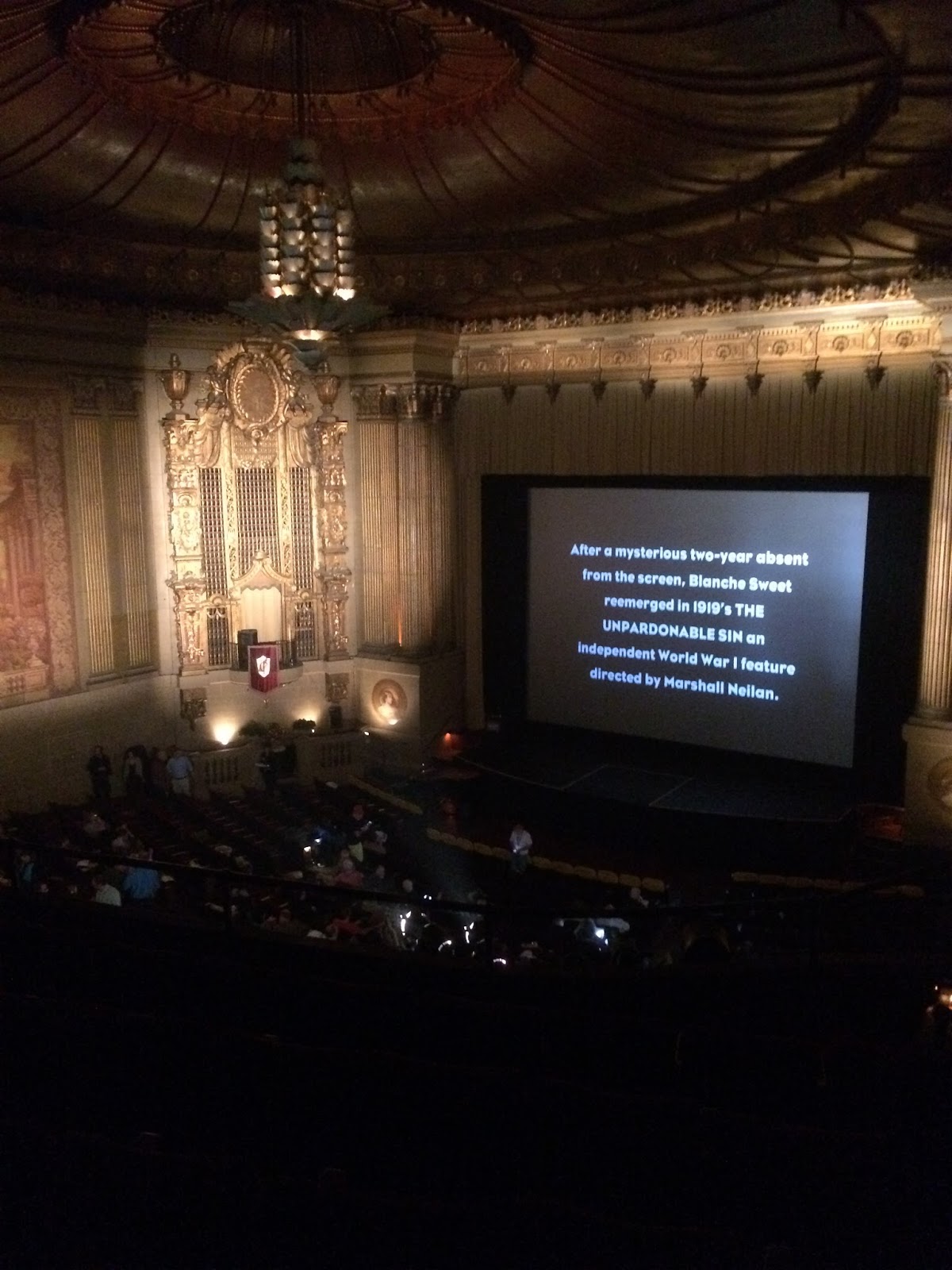
Five days. Nineteen programs. I was able to see parts or all of 11 programs and 15 films. All in a "picture palace.", the magnificent Castro Theater.

Each film had a musical accompaniment, sometimes a single piano and violin player, sometimes a small ensemble, and in one case an entire silent film orchestra:

The music is an integral part of silent film. Byrony Dixon in 100 Silent Films, describes it like this: "The feature length silent drama, with its combination of images and musical accompaniment, is perhaps most analogous to opera, with its own vernacular and appeal to obsessives and enthusiasts." (p. 1). In each film, within seconds, the music merged into the film. This was a tribute to the quality of the musicians.

I felt as if I were time traveling while watching these films. This must have been something like what watching a silent film in the 1920s was like. The other thing that really struck me was just how visual a medium film is. That would seem to be obvious, but when you watch a modern film, ask yourself how much of your enjoyment of the film comes from the images alone. If you watch a silent film seriously, as was stated by King Vidor in the 1st installment of Hollywood, you cannot take your eyes off the film. Not for a second. Not to look into your popcorn or to locate your drink. If you do you will miss something. Seriously watching a silent film demands much more concentration, in my opinion, than watching a sound film. It is work, but tremendously rewarding.

I loved everything I saw. Two films stood out in my mind. One was the above mentioned The Last Man. Watching it on Youtube or even on a film class screen is barely watching it at all. Projected in all its glory on the big screen, accompanied by a symphony orchestra, the film is an overwhelming experience. I don't know enough about film to try to get into why F.W. Murnau was among the greatest of film directors in the history of cinema. The plot of the film is that a hotel doorman is demoted to washroom attendant. That is all. But the themes of human degradation and redemption are universal.

There is no dialog in the film.

There are title cards, but no dialog. Murnau was able to tell an emotionally complex story with images alone. Think about that the next time you watch a film. The other film was Jacques Feder's Visages D'enfants (1925). It is about a world seen through the eyes of a child. It is subtle and powerful, a film I knew nothing about by a director I also knew nothing about. A great discovery for me. It was a beautiful film, one that elicited tears at the end.  Flesh and the Devil (1926) (excerpts only) (mainly the sizzling chemistry between John Gilbert and Greta Garbo—simply a reflection of what was actually going on between them at the time) was also compelling viewing.

There were many other films. You can read articles about all of them at:

Click on “Festival Year” next to “Archive by” on the right side of the page. Or simply search for year (as Festival Year browse isn't available as of 10/14/18)>

 Some were better than others. But I enjoyed every one I saw. I also bought some books and dvds. Something to keep me going until next year's festival. My greatest disappointment was missing Brownlow and Dixon sign copies of their books that I bought after one of the films. I stepped out of the theater to stretch my legs, not realizing that, even with my full pass, I couldn’t re-enter until  the next film.

A very large part of this festival was also about reclaiming and restoring lost films. It has been estimated that around 90 percent of all the silent films produced before the advent of sound have been lost. Films were trashed for the silver in the stock after they had their runs. Or they burned. There was an interesting demonstration at the festival that compared the burning of safety stock to silver nitrate stock. The nitrate exploded into flames. It demonstrated how dangerous a job projecting a film on this stock was. William Fox's New Jersey warehouse burned in 1937. Most of the Fox archive was lost.

Many people have been instrumental in the reclamation and restoration of silent films. Kevin Brownlow was one of the first. Serge Bromberg, who addressed the festival on more than one occasion, is one of the most important. See his Lobster Films for more on this. Many national archives are also involved in this. One of the joys of this festival is that it presents one or more of the latest films to be found and restored. And they are restored magnificently.The last time silent films looked as beautiful as they do today was when they were first exhibited.

As I said at the beginning, silent films are an acquired taste. I know people who can't watch 10 minutes without becoming uncomfortable or falling asleep. But if you can get over the fact that there won't be any yack yack yacking (to paraphrase Gloria Swanson caricaturing herself in Sunset Boulevard), check out some of the examples above, especially the documentaries, which are filled with excerpts. Enjoy the act of watching the "high art of pantomime." You might discover something that you weren't expecting.

Selected Internet sources of silent film:

Online:

Archive.org silent films

Hundreds of silent films, available free of charge. Organized in multiple ways.

Openculture.com silent films

The site says 101 free silent classics. Judge for yourself.

Fandor

(fee based but very reasonable). Hundreds of silent films, categorized by genre, country, and time period.

Thanhouser Company

An independent film studio in New York that operated from 1909 to 1918. The site contains a complete history of the studio, along with 57 films available for free online and many more on dvd.

If viewing some of these (various levels of completeness and clarity for the first two above) intrigues you and you'd like to buy copies that are in better shape:

Milestone Films 

Excellent eclectic collection, highlighted by a collection of ten dvds covering pre-revolutionary Russian silent film (Starewicz, Bauer, Protozanov, etc.). At the above address click on "select a product" for links to information, including pricing information about all available silents.

Kino Lorber 

over silent 150 films available

Flicker Alley

Select catalog of silent films. Flicker alley offers dvds, streaming, and made on demand films. Click on "shop" and search "silent".

Grapevine Video

Eclectic collection, quite a few "not classics." But also some gems,like Beggars of Life (1928) directed by William Wellman and starring Louise Brooks. Also White Hell of Pitz Palu (1929--American version). Directed by Arnold Fancke and G.W. Pabst, featuring Leni Riefenstahl.