Wednesday, March 23, 2016

The week in Basque Pelota (ball) Court Sports--Mar. 13-20, 2016--Part I


A couple of things right off the bat. This is what I call an “illustrated” report. I know many of you have never seen the sports I will be updating in these reports. This one is particularly detailed, to give you a basic idea of how they work. Refer to this report from now on if you follow these reports. But, as with all sports, pictures are worth a thousand words. If you are going to watch the matches I link to (and hopefully the ones you find yourself later), don’t watch them on a smart phone, tablet, or laptop. Get a gadget to hook your hardware up to your large screen TV. The ball is too small, the courts are too big, and the speed of the ball during the games, with the exception of the first modality we will deal with, mano (handball), is simply too fast to follow on your small screens. Believe me, I have tried. It’s so easy to dial up the smart phone and watch. But you will be cheating yourself. Put these games on a big screen, sit back, and be amazed. There are no individual court sports in the world anything like these. And you’ll get to feel how it felt when you saw your first baseball, football, or basketball  game. How it feels to learn a game you’ve never seen before. I will try to give you not only introductions to these sports, but provide the larger context of the game. In many cases that is difficult, and especially so for a sport that I experience in two foreign languages (Basque and Castillion Spanish), three if you count French, where the great St. Jean de Luz summer festival of Jai Alai is held in July and August of every year. But I will try my best and hope to provide you with links to some great entertainment.

 There are many Basque court sport modalities. Four are played professionally and so get exposure on the EITB Basque Television network. I will let you know when and how to access live games when available. But much of what you will see, if you develop an interest, will be on demand replays. The only modality that is broadcast live over the Internet (so far as I know) is mano. The other three sports we will cover are pala (long bat), erremonte (remonte in Spanish) (racquet—though it looks nothing like any racquet you have ever seen),and Jai Alai (cesta punta in Spanish) (basket). They are all sports where players hit the ball onto a wall (indirect court sports) and the other team returns it, except for Jai Alai, which is a catch and throw sport. Scoring occurs when one team or player (doubles or singles) hits or throws  the ball where the other team or player cannot return it. Balls can be hit or caught on the bounce or fly. Indirect court sports are fundamentally different from direct court sports like tennis or the Valencian pelota sports of Raspall (scrape) and Escala I Corda (stair and rope), in which a there is usually, but not always a divider (net) between the sides. I am just learning the Valencian pelota sports, so a little later, I will have something more to show you.

Take what you like from these reports. I love all the modalities. You may or may not. The main thing is to enjoy something that has been very important in Basque culture for centuries.  

How did I get here?  In the last fifteen years, I have wondered from American sports. First I went to cricket, which I had a 10 year obsession with, an obsession that was finally broken when the powers that be in that sport made no attempt to fix it after three major match fixing scandals. So I broke up with cricket (though not completely, I’m afraid). Then, at a time when I found I had time on my hands, I discovered Jai Alai through the simulcasts of the performances (pari-mutual sports events are called performances) in Miami and Dania Beach, Florida. I don’t care for pari-mutual  sports because of the context of the games, but watching the Jai Alai was mesmerizing. They don’t really throw the ball at 150 mph as they constantly advertise (I’ve seen games in Spain that were clocked with a speed gun. They top out at about 130 mph, but the average speed the game is played at (except for drop shots) is between 90 and 100 mph. Which is amazingly fast. That led me to research on Basque pelota sports and where they were televised.

Also I have a lifelong interest in stick and ball sports, or hit the ball with your hand sports. I played the ones below for many years when I was younger. Always played against opponents who were better than I in the hopes that I would get better. I did, but never better enough. Not by a  long shot. But it was great fun. The sports I played are linked to below in order to give you the context that I had when I found the Basque pelota sports.

US individual court sports 


Match starts at 11:45 on the recording


Match starts at about 15:00 on the recording. Note the difference in size between a  singles and doubles squash court.

Report for the week.

1. Mano (Handball)


Mano:  If you aren’t fluent in the metric system, a  mano short court is 118 feet long and 33 feet wide, with a wooden apron that is out of play if the ball lands directly on it, but can be retrieved from it in the air. The apron width varies by fronton. Front and back walls 33 feet high and 36 feet wide. The sidewall 33 feet high, 118 feet long.  The ball must hit the front wall above 1 meter high (about 3 feet). The first thing you will notice about all Basque courts is their enormity.

Context:  14th Doubles Championship:


Top four into semi-finals. 3 semifinal weeks.

EITB, the Basque Television Network, usually broadcasted three of four of the matches every weekend. Those matches are available on demand
Roll the mouse over  “Categorios”, then “Deportes” , then roll down to “Pelota Eskuz Professionalak 2016” and click on that.  6 horizontal pages of matches will appear at the bottom of the screen. At this point it gets a little complicated (it took me a couple of days to figure it out and I’m pretty motivated about this stuff). If there are any league matches you are interested in, contact me and I will find them for you (if they were broadcast). It’s really a terrific service of EITB, making so many of these matches available on demand. They also provide a wonderful selection of finals doubles and singles matches going back several years  (follow the same path as above but open the “Finilak” tab directly below the 2016 tab).

Another place to get on demand mano matches, much more easily, is at Fronton TV.   They don’t have as many of this year’s doubles league matches, but they have a wonderful selection of doubles, singles and singles Quattro e Medio  (Lau eta Erdico) matches (a special type of singles match that we’ll cover when those tournaments happen later in the summer and fall).


Last week, on Saturday and Sunday, the second round of semi-final playoff matches were played. There are three rounds of semi-final matches. The first round, the top team plays the second place team and the third place team plays the fourth place team. This is very different from  American sports playoffs. What it does is set up a second week’s playoff where the two winners play each other in one match and the two losers in the other. It almost always sets up a scenario where the winner of the winner’s bracket is promoted to the final, and the loser of the loser’s bracket is eliminated. Then the third week of semi-finals consists of one elimination match and one “dead rubber”match (a match between a finalist and a team that has already been eliminated). A smart way to get an extra week of playoffs and extra revenue. Also one more chance for the fans to see the players.

2nd Semi-Final Match One. Mar. 19, 2016

At Pamplona  Labrit Fronton

Very nice pictures of the outside and inside of the fronton.

A note about players’ names, in this modality, and all other professional modalities. The players have a “playing name”, a single name that is usually their personal  name or family name. Roman numerals after the name mean that there is at least one other professional player with the same playing name.
Games are played to 22 points. There is a point on every serve. Service changes sides when the other team scores a point.


The first name of the team is always the front court player and the second is always the back court player. Front courters are usually small, quick, and have deadly kill shots. The last two weeks, Olaiazola II has been on fire. Back court players are bigger and stronger and do the donkey work in this sport, returning  50 to 100 times from 60-80 feet away. Watch and you will be amazed at their strength. And feel the pain in their hands.

A note about balls used in these matches. During the week before the match, each team chooses 3 balls that it will use in the match. This is followed closely by the press and there are newspaper stories about it. For this match, the weights of the balls chosen were:

Olaizola II-Urrutikoetxea-105.1; 106.0; 105.8 g
Bengoetxea VI-Untoria     104.8; 105.1; 105.1 g

Whenever the service changes, the ball changes. The broadcast sometimes notes which ball is in play. In this match it didn’t.  These players apparently can feel the difference 1/28th of an ounce makes.

O-Urr 22 B-Un 10


The key to the game stories are the data at the bottom. Total number of shots are usually given, along with a set of statistics next to each player’s name. All players’statistics except the last one are for “winners.” “Sakez” is a service ace. “Errores” or “fallos” are errors. The sum total of your team’s winners and the other team’s errors adds to your team’s score. For example, in this match, O-Urr’s  winners added to  15 and B-Un’s errors added to 7, making 22 for O-Urr. Similarly, O-Un’s winners added to  8 and O-Urr’s  errors added to 2, making 10. 22-10 was the final score. Olaiziola II’s winners added to 14. Anything over 10 is a great day. His cross court kill shot was magnificent, unplayable. He sat on the left front about 25-30 feet from the wall waiting for errant long shots from Untoria  like a bear waits for a salmon, and pouncing on the slightest of mistakes (mistakes that don’t show up as errors in the statistics, they show up as winners for Oliazola II). If you look at the game statistics, you will see that Urrutikoetxea did not make any errors. He hardly ever gave Bengoetxea VI a chance to get his team back in the game. Urrutikoetxea has unlimited potential. He has won singles tournaments, showing that he is what is very rare in this game, an all round player, a back courter who can also play up. If you haven’t ever seen pelota mano and want to start by watching this game, you couldn’t chose a better game to watch. This game wasn’t close, but they rarely are when one team is playing so close to perfection. 


If you wish to see O-U’s first semifinal v Mts. de Irujo-Restuza (the team that went 13-1 in the league phase), it is on the same page as the full game replay of this match. Olaizola II, was, if possible, even better in that game than in this one.

Second Semi Final Match 2, Mar. 20, 2016

Played at Eibar Astelena Fronton


M-R 22, A-A 16.

With the loss, Artola-Albisu were knocked out of the tournament.


The key to this game was an injury to Artola at 14-14. He tried to retrieve a long shot off the wall by Rezusta and badly sprained a finger. He had to leave the game but came back. Unfortunately he couldn’t play with any effectiveness after this and Mts.’ team went on to score 8 of the next 10 points, winning easily.   


Full game replay (featured semi-final begins at 1 hour and ten minute mark on the recording).

Mts-Resusta now meets Bengoetxea VI-Untoria   this coming Sunday at
Vitoria’s Ogueta Fronton. The game can be seen live on EITB this Sunday at:


The matches begin at 11:00 am Central Daylight time. The feature semi-final  begins at about noon.

The other semi-final, the one that has no effect on the final, between  Olaizola II-Urrutikoetxea and  Victor-Albisu (Artola’s injury has sidelined him), will be played at

Pamplona  Labrit Fronton  on Saturday. The matches begin at noon, CDT, with the feature match at about 1:00 pm. Use the above address to access that match if you are interested.

I had planned to update the other three sports in this report, but, because of its length, I will do that in part II of this report.

Cheers and enjoy the game.

Sources:

Asegarce Entertainment Company --Player, match, and Fronton information.

Aspe Entertainment Company--Player, match, and League table information


 EITB Television Network--Matches and highlights.

Fronton TV (click on "Videos" then "Programmas").--Matches

Wikipedia article on Basque Pelota--basics and dimensions of the sport.

Tuesday, July 7, 2015

Impressions:The 2015 San Francisco Silent Film Festival

Impressions: The 2015 San Francisco Silent Film Festival


Part 1: How I got here.
Caveats:

1. I am not a film scholar, historian, or critic. I am a person who loves to watch and read about films. I got the idea that attending a silent film festival might be a great vacation. The fact that the festival was in San Francisco was pure gravy.  That idea coming to fruition after a two year gestation period is the source of this entry.

2. This entry will be peppered with Youtube Internet addresses. These addresses are for your entertainment and perhaps, edification.  Note that:

A. There may be problems with copyright for some of these addresses. My philosophy is live and let live. It is Youtube’s problem, not mine. Look at anything you like. Downloading or copying may be illegal.

B. These addresses are ephemeral. What is at Youtube today may not be there tomorrow, or may be available at a different address or a different site entirely. I use Youtube for convenience and breadth of coverage There are other sites. Openculture.com and Archive.org are two. For that reason, I will give titles and authors, which you can search, as well as addresses which I have found. At the end, I will point you to some places I have found useful if you want to watch online or purchase titles you might be interested in.

C. I will give examples that I have found particularly useful. The best way to find more examples of a director’s style is to search Youtube by that director’s name.

D. After clicking on any link, click on the back button to get back to the blog item. 
=====================================

It should be said, to begin with, that silent film is an acquired taste. Just like several other acquired tastes that have occupied (obsessively, some would say) my time over the years (cricket, chess, astronomy, opera, the US Civil War, Basque court sports (cesta punta, remonte, pala, paleta gomaxare, pasaka, frontenis, joko garbi, rebotbote luzea, grand chistera,  main nue, and mano, for those who are interested), other Basque sports (wood chopping and giant ball picking up and dropping, other Basque "rural "Basque boat racing, sheparding), and one Italian sport (calcio storico) so crazy that...well, see for yourself), it is difficult to trace where, when, or exactly how my "interest" was piqued.

What I can say about silent films is that my interest coincided with the free guest auditor classes I began taking at my university when I turned sixty. Any resident of my state, at age sixty, can take university classes for free. A remarkably progressive policy. I am trying to take as many as I can as quickly as I can.

The very first class I took was Film History from the beginning to 1960. In this class we were exposed to the very birth of the art:

Eadweard Muybridge:  The Weird World of Eadweard Muybridge

The Lumiere Brothers:  Moving Pictures: The Lumiere Brothers

Edwin S. Porter

A. The Life of an American Fireman  (1903)

B. The Great Train Robbery (1903)

Cecil Hepworth: Rescued by Rover  (1905)

D.W Griffith:  A Corner in Wheat (1909)

Shortly after that, we saw Charlie Chaplin in Easy Street (1917)

and

Buster Keaton in The General  (1927)

All of which was prelude to one of my favorite films:

F.W. Murnau's The Last Laugh

Seeing these films lead me to a book by Kevin Brownlow: The Parade's Gone By...

and two documentaries by Brownlow and David Gill:

A. Hollywood: A Celebration of American Silent Film (1980)

B. Cinema Europe: The Other Hollywood (1995)

Parts 1-5:


By now silents were taking up quite a bit of my time.

The second class I took was on documentary film. We watched Robert Flaherty's Nanook of the North (1922)

The fourth class I took was on Russian film. From the stop motion animation of Ladislaw Starewicz: The Cameraman's Revenge (1912)

To the melodramas of Evgeni Bauer:  The Dying Swan (1917

and Yakov Protazanov: Father Sergius (1918) (click on CC for closed caption English subtitles.

To early Soviet silent film: L.V. Kuleshov:  The Extraordinary Adventures of Mr. West in the Land of the Bolsheviks

Sergei Eisenstein: Strike (1924)

Dziga Vertov: The Man with a Movie Camera (1929) (no subtitles, but they are really unnecessary 

and Vsevolod Pudovkin : The End of St. Petersburg (1927)

I was exposed to more great silent films. I started watching some of my own, which I have chronicled elsewhere in this blog (An interesting movie and Mr. Eisenstein meet Mr. Gance).

What I learned from all of this was that

1. Silent films were never silent. 

2. Silent films were an art unto themselves, not an evolutionary step on the way to sound, wide screen, etc. A "great art of pantomime," as one of the documentaries stated. An art form that was kneecapped at its height for commercial reasons. At about this time I started going to the Music Box Theater in Chicago, where they have a silent showing the second Saturday of every month.

I also learned of two magnificent silent film festivals. One is in Italy, the Pordenone Silent Film Festival

A bridge to far for me. The language, cultural, and financial barriers are too intimidating. But the other one is in San Francisco, an amazing city that is within my reach, culturally, linguistically, and financially.

Part 2: The 2015 San Francisco Silent Film Festival


It took me two years to finally get up the courage to go. It did not disappoint.

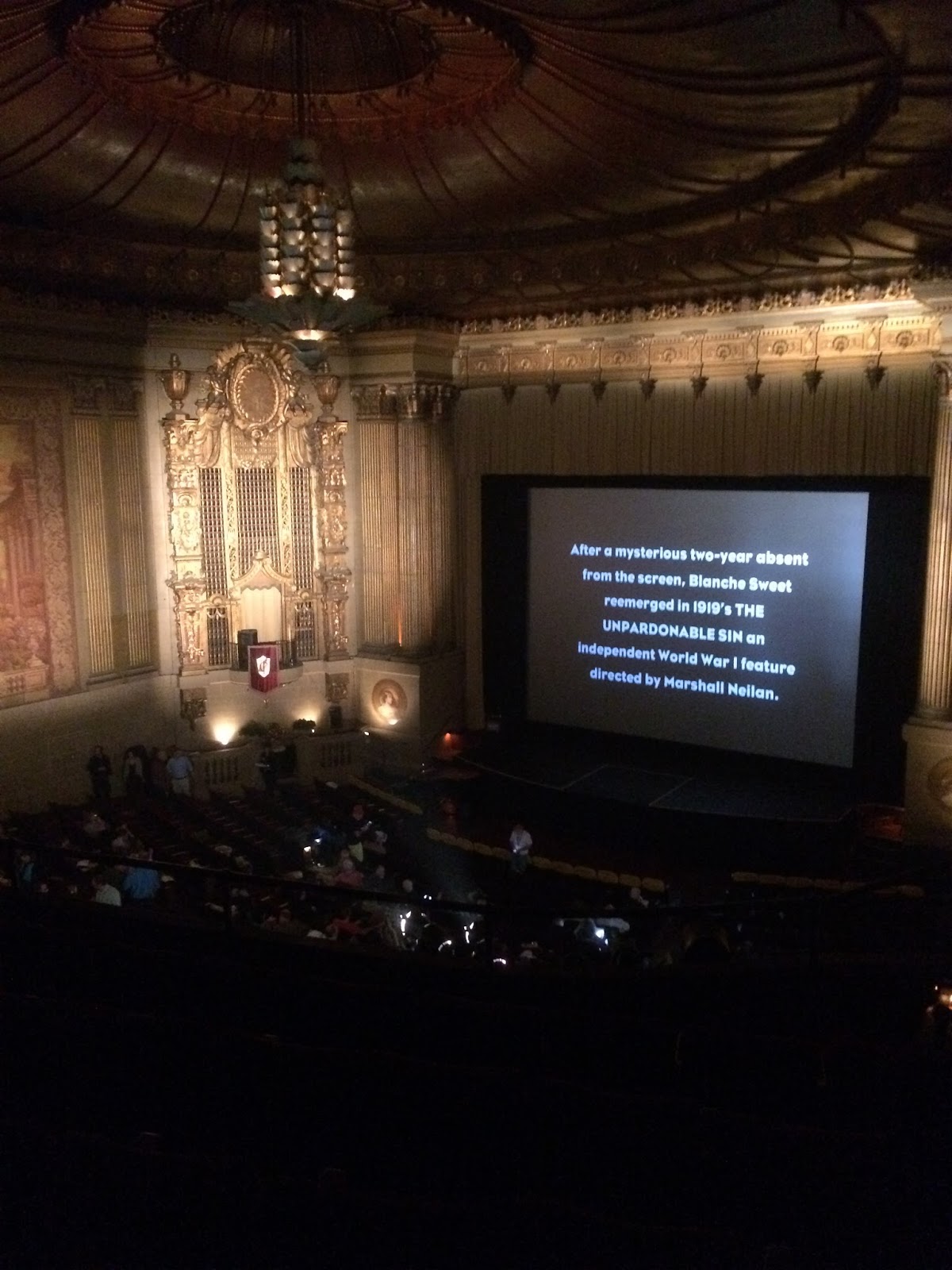
Five days. Nineteen programs. I was able to see parts or all of 11 programs and 15 films. All in a "picture palace.", the magnificent Castro Theater.

Each film had a musical accompaniment, sometimes a single piano and violin player, sometimes a small ensemble, and in one case an entire silent film orchestra:

The music is an integral part of silent film. Byrony Dixon in 100 Silent Films, describes it like this: "The feature length silent drama, with its combination of images and musical accompaniment, is perhaps most analogous to opera, with its own vernacular and appeal to obsessives and enthusiasts." (p. 1). In each film, within seconds, the music merged into the film. This was a tribute to the quality of the musicians.

I felt as if I were time traveling while watching these films. This must have been something like what watching a silent film in the 1920s was like. The other thing that really struck me was just how visual a medium film is. That would seem to be obvious, but when you watch a modern film, ask yourself how much of your enjoyment of the film comes from the images alone. If you watch a silent film seriously, as was stated by King Vidor in the 1st installment of Hollywood, you cannot take your eyes off the film. Not for a second. Not to look into your popcorn or to locate your drink. If you do you will miss something. Seriously watching a silent film demands much more concentration, in my opinion, than watching a sound film. It is work, but tremendously rewarding.

I loved everything I saw. Two films stood out in my mind. One was the above mentioned The Last Man. Watching it on Youtube or even on a film class screen is barely watching it at all. Projected in all its glory on the big screen, accompanied by a symphony orchestra, the film is an overwhelming experience. I don't know enough about film to try to get into why F.W. Murnau was among the greatest of film directors in the history of cinema. The plot of the film is that a hotel doorman is demoted to washroom attendant. That is all. But the themes of human degradation and redemption are universal.

There is no dialog in the film.

There are title cards, but no dialog. Murnau was able to tell an emotionally complex story with images alone. Think about that the next time you watch a film. The other film was Jacques Feder's Visages D'enfants (1925). It is about a world seen through the eyes of a child. It is subtle and powerful, a film I knew nothing about by a director I also knew nothing about. A great discovery for me. It was a beautiful film, one that elicited tears at the end.  Flesh and the Devil (1926) (excerpts only) (mainly the sizzling chemistry between John Gilbert and Greta Garbo—simply a reflection of what was actually going on between them at the time) was also compelling viewing.

There were many other films. You can read articles about all of them at:

Click on “Festival Year” next to “Archive by” on the right side of the page. Or simply search for year (as Festival Year browse isn't available as of 10/14/18)>

 Some were better than others. But I enjoyed every one I saw. I also bought some books and dvds. Something to keep me going until next year's festival. My greatest disappointment was missing Brownlow and Dixon sign copies of their books that I bought after one of the films. I stepped out of the theater to stretch my legs, not realizing that, even with my full pass, I couldn’t re-enter until  the next film.

A very large part of this festival was also about reclaiming and restoring lost films. It has been estimated that around 90 percent of all the silent films produced before the advent of sound have been lost. Films were trashed for the silver in the stock after they had their runs. Or they burned. There was an interesting demonstration at the festival that compared the burning of safety stock to silver nitrate stock. The nitrate exploded into flames. It demonstrated how dangerous a job projecting a film on this stock was. William Fox's New Jersey warehouse burned in 1937. Most of the Fox archive was lost.

Many people have been instrumental in the reclamation and restoration of silent films. Kevin Brownlow was one of the first. Serge Bromberg, who addressed the festival on more than one occasion, is one of the most important. See his Lobster Films for more on this. Many national archives are also involved in this. One of the joys of this festival is that it presents one or more of the latest films to be found and restored. And they are restored magnificently.The last time silent films looked as beautiful as they do today was when they were first exhibited.

As I said at the beginning, silent films are an acquired taste. I know people who can't watch 10 minutes without becoming uncomfortable or falling asleep. But if you can get over the fact that there won't be any yack yack yacking (to paraphrase Gloria Swanson caricaturing herself in Sunset Boulevard), check out some of the examples above, especially the documentaries, which are filled with excerpts. Enjoy the act of watching the "high art of pantomime." You might discover something that you weren't expecting.

Selected Internet sources of silent film:

Online:

Archive.org silent films

Hundreds of silent films, available free of charge. Organized in multiple ways.

Openculture.com silent films

The site says 101 free silent classics. Judge for yourself.

Fandor

(fee based but very reasonable). Hundreds of silent films, categorized by genre, country, and time period.

Thanhouser Company

An independent film studio in New York that operated from 1909 to 1918. The site contains a complete history of the studio, along with 57 films available for free online and many more on dvd.

If viewing some of these (various levels of completeness and clarity for the first two above) intrigues you and you'd like to buy copies that are in better shape:

Milestone Films 

Excellent eclectic collection, highlighted by a collection of ten dvds covering pre-revolutionary Russian silent film (Starewicz, Bauer, Protozanov, etc.). At the above address click on "select a product" for links to information, including pricing information about all available silents.

Kino Lorber 

over silent 150 films available

Flicker Alley

Select catalog of silent films. Flicker alley offers dvds, streaming, and made on demand films. Click on "shop" and search "silent".

Grapevine Video

Eclectic collection, quite a few "not classics." But also some gems,like Beggars of Life (1928) directed by William Wellman and starring Louise Brooks. Also White Hell of Pitz Palu (1929--American version). Directed by Arnold Fancke and G.W. Pabst, featuring Leni Riefenstahl.


Wednesday, December 10, 2014

Harvey Goldberg Lecture--Beginnings of Capitalism (in England)--1977--Revision

I have finished my third Harvey Goldberg lecture transcription: Beginnings of Capitalism (in England).

Original audio lecture (#41) is available at:

https://web.archive.org/web/20120511113937/http://brechtforum.org/harvey-goldberg-lectures

Audio link in the transcript may be out of date.

You can read it at:

Microsoft Word:

https://docs.google.com/document/d/106gnopx7L-taeTnZLFSKsKI_vlzZ50bj5Resb3XqaFE/edit

If you'd like an HTML file to work with, simply download the Word file as an HTML file and then open it in your browser

The transcription is annotated and contains two bibliographies at the end of the lecture.

 Dec. 22, 2014, I have revised the Word Document. I found the reference to the biographer of William Stumpe. It was J.W. Gough in a book called The Rise of the Entrepreneur.  It now appears as footnote #26 in the document. Footnote #22 (referring to William Stumpe) has been expanded to find other biographical sources for him. 

Goldberg mentioned "Stumpe's biographer," who I was pretty sure was named "Gough." But when I looked up Gough and Stumpe in WorldCat (the most powerful catalog lookup tool on the planet), I couldn't find a biography anywhere. So I thought I was incorrect about "Gough" and thus called the biographer's name "unintelligible" (an easy but unsatisfying solution to my problem). It wasn't until later that I thought to look in the periodical literature. Almost instantly I was able to find a review of Gough's book listed above that mentioned Stumpe. Presto, I found the book, the quote, and the footnote about the quote that mentioned it was a paraphrase from G.D. Ramsay's The Wiltshire Woolen Industry in the Sixteenth and Seventeenth Centuries. The footnotes in these two books led me to Thomas Fuller's History of the Worthies of England (Vol. 3) and Canon Manley's "William Stumpe of Malmsbury" in Wiltshire Notes and Queries No. VIII. There lay much more biographical information on Stumpe, which you can now see. See  the above footnotes for more on all this.

Fuller and Manley are easy to find online. But I wouldn't have found them at all if not for Gough and Ramsay. And that is where the awesome power of a major university research library comes in. My university has one of the largest research libraries of any public university in the US. Having access to it is a great gift and privilege for me. Not only can I see how many sources Goldberg was into, but I can see the sources. The man's scope and breadth of reading was phenomenal. I've done three lectures so far and there is a semester's worth of reading in each lecture. Think about that the next time you take a university class.


I am trying an experiment with Google Docs. Supposedly you will be able to read the Word file. Google has changed some things with Google Docs since the last time I uploaded. Whether any of this will work for you is a mystery to me. Feedback would  be welcomed at:.

jbsolock1@gmail.com
Please put "Goldberg Lectures" in the subject line.

The Microsoft Word links, though appearing to be live, may not be. If single or double clicking on them doesn't work, save the file and use the links directly. Once you have a live, working Word document,  to get the links to work, just hit the CTRL key and  left click the mouse on the link simultaneously. Links that, in the future, might move or die, should be cut and pasted into the Wayback Machine at

http://archive.org

That is the best way to recover lost links at present. Each link was checked and worked at the time of release of this blog item.

I hope the transcription is legible to you.

Enjoy.

For exclusive links to all Goldberg transcriptions on this blog click "Goldberg" next to the "Labels" tag at the bottom of this item. The next transcription will be #42: Luther Wunzer [sic]. Wunzer is actually Thomas Muenzer.

BTW: Who's Harvey Goldberg, some of you might ask? See

http://en.wikipedia.org/wiki/Harvey_Goldberg

Monday, November 17, 2014

Claude Debussy and Rudolf Nureyev meet Quentin Tarantino.

What could Debussy and Nureyev possibly have in common with Tarantino? Nothing. And that is a bit of a story. Care to hear it? OK.

I'm taking two free University courses as a senior guest auditor (over 60=free classes at my university). They meet back to back at 11:00 am--(The Symphony--my first non-film class) and 12:05 pm--(American Film--1970-Present). It has been a difficult juxtaposition all semester and today it was so difficult that I had to write something.

First, let me say that the instructors in these classes are top notch. Fabulously knowledgeable. Very enthusiastic. Have a deep and abiding love and respect for their subject. A very enjoyable break in my  Mondays and Wednesdays. So wonderful that the University has a place for art for its own sake. No questions about how it helps the economy of the state. Not as (as Harvey Goldberg used to say) "a vendible commodity." Just art. Universities have a great civilizing function. We shouldn't forget that in the darkness that is today's world.

That said, many of the American films of 1970-present have an unmistakable streak of violence and mysogyny. Of the films we've seen so far, examples are Taxi Driver, Blade Runner, Die Hard, The Silence of the Lambs, L.A. Confidential, and Jackie Brown. These films are all demonstrative of other trends in American film in the time period. In that way they are important indicators of different concepts, which I need not go into here. But the undercurrent of violence and mysogyny, and the all too often romanticization and fetishization of that undercurrent wears me down. After seeing these films, I often wonder what being shot must feel like. It must hurt. I wonder if all the watching numbs me to the pain. But I watch. And watch.

The music class offers me nothing but great classical music, deconstructed. It is beautiful and soothing. Most of my friends took this class when we were undergraduates, some 40-45 years ago. I resisted because I felt it might be too difficult for me. I was correct. I am far beyond the power relationships of a university class, the judgement that goes with exams and papers. Been there. Done that. Three times. But the class is difficult. Music is mathematical. I am not. It is a language. I am fluent in only one language. There is a depth to it far beyond what I can comprehend. It has always been background in my life. Good music gets my mind into a riff and I fantasize and forget where (and sometimes who) I am. I am learning there is lots more to great music than that. But mostly it is just beautiful to listen to. Always puts me in a great frame of mind.

Then the class ends and I go to the film class. And that's where the juxtaposition problem begins. So far, Mozart's Symphony No. 40 has been juxtaposed with a deconstruction of Die Hard. Beethoven's Ode to Joy with The Silence of the Lambs. Etc. The mood swings are difficult.

Today, I think, was hardest of all. In the music class, background on Claude Debussy and the end of Romanticism. The beginning of modern classical music. The example was Prelude to the Afternoon of a Fawn. About 12 minutes of the most beautiful music I've ever heard. And not just the music. The instructor found a video of a balletic interpretation that was choreographed by Nijinski and danced by Nureyev. Prelude is a sensual piece. Nureyev, it seemed to me, made love with it. It was beautiful. My feet barely touched the ground as I made my way to the film class.

And there was a deconstruction of Tarantino's Jackie Brown. The instructor absolutely nailed the deconstruction. After 10 weeks, I expect no less, and he always delivers. Makes you think in many different ways, with many different concepts about these films. Almost makes me forget the brutality that is Tarantino. Jackie Brown is actually, of the Tarantino films I've seen, one of the more thoughtful and sensitive. But it's still Tarantino. The deconstruction was perfectly timed, and reached a crescendo with a clip of one of the murders in the film. Below I have linked to both the Debussy and Tarantino. Both are art. Both are done by artists who are almost impossibly gifted. One brought me to heights of joy. The other crashed me on my head against the concrete. Art is complex and difficult. These two classes are dialectical in a way. I haven't figured out what the synthesis is yet. Maybe there isn't any. 

Claude Debussy: Prelude to the Afternoon of a Faun. Joffrey Ballet.

Choreography: Vaslav Nijinski. Principle dancer: Rudolf Nureyev.

https://www.youtube.com/watch?v=2GqGVkfUip8

Jackie Brown, Directed by Quentin Tarantino

Murder of Louis:

Part 1:

https://www.youtube.com/watch?v=Fh-7WQr_daM

Part 2:

https://www.youtube.com/watch?v=3e7wbs_xfas

Monday, February 17, 2014

Mr. Eisentein meets Mr. Gance


This semester, as I am of an age where I can take University classes for free, I am taking a course in Russian film history. It is a marvelous course taught by a master instructor, which makes it a joyous experience for me. This is my fifth free film class. Four of them have covered a history from beginning to present: general film history-in two parts over two semesters, documentary film history, and this one. The great thing about the total film histories is that I get to see lots of silent films.

I am developing quite a passion for silent films. I’ve talked about some of the other ones I’ve seen in another blog entry (An Interesting Movie), and there are many great, accessible American, German, French, Scandinavian, and Japanese silent films. But I knew nothing about the Russian silent film tradition before taking this class.

The main text of the class is A History of Russian Cinema, by Birgit Beumers. I’m not sure of this, but this appears to be a volume that could supplement (or supplant) Jay Leyda’s classic Kino: A History of the Russian and Soviet Film as the go to source for the beginner in the topic. There is usually a chapter a week of reading in the Beumers book. Most of the film histories I’ve read intersperse the political, social, and economic background of the history with discussions and partial deconstructions of representative films of the time. And that is my problem. Since I always have a laptop close by when I read, and since most of the films discussed are not readily available (unless I want to wait for inter-library loans), I enter titles into Youtube, just to see what might be out there.  I have found that Youtube is an incredible film resource. There is more there than you can imagine. Yes, much of it is copyright violation, but that’s their problem, not mine. I just know that if I find something, I need to watch it, because it may not be there tomorrow.

And so the first week’s reading, about the beginnings of pre-revolutionary Russian cinema, were designed to get me ready to watch and discuss the first film on the syllabus, Jacov Protazonov’s Father Sergius (1917--click on cc for English subtitles--found November 2018). I never did find a proper copy of that on Youtube, but I barely got to it at all. I had to watch it on a dvd in the library as I couldn’t make the full screen showing. Father Sergius is a Tolstoy novella which the instructor assigned so that we would understand the difficulties of filming what is basically a psychological story. And it is an amazing film. Russian pre-revolutionary cinema was highly theatrical, very rich, with long takes and great depth of shots that showed everything going on at the same time, as opposed to the editing techniques pioneered by American films. It’s a very lyrical, almost poetic cinema. Beautiful to watch.

But on my way to Father Sergius, I learned about the origins of Russian cinema, and there, at Youtube, were those origins:  three very early and very short classics. They are all melodramas and they all have unhappy endings, a hallmark of early Russian film.

StenkaRazin (Vladimir Romashkov-1908--click on cc for English subtitles), the first Russian film, 

Princess Tarakanova (Kai Hansen and Andre Maitre-1910), 

Rusalka (Vasili Goncharov-1910)


Once I found them, my reading ended for  a while.

My reading really got hamstrung that first week when Beumers started talking about Yevgeni Bauer  (master of the early Russian melodrama) and Wlasdyslaw Starewicz (one of the earliest of animators in any cinema) and-via a non-Beumers inspired detour through Youtube- his connection to Emile Cohl, a French animator whose work inspired Starewicz’. Well, I spent a whole Saturday watching amazing Strarewicz stop motion (especially The Cameraman's Revenge) insect and puppet animation, early Cohl animation,  and Bauer melodramas (all of which had unhappy endings) (selected films have English subtitles--for the ones that don't have hard subtitles, try settings--the gear--subtitiles). They are all right there on Youtube. You need only type in the directors’ names to get the films. What an education. All I knew about Russian film was Eisenstein, Pudovkin, Dovzhenko, and Tarkovsky. 

The second week was easier, as we concentrated on the first great theorist of Russian cinema, LevKuleshov and viewed his famous satire The Amazing Adventures of Mr. West in theLand of the Bolsheviks (1924). Kuleshov theorized about the power of editing in cinema, how it is the most powerful aspect of cinema, more powerful than story or acting. You can see it unfold in Mr. West on Youtube. Lots of fun. In addition to the text, we were asked to read about 100 pages from Kuleshov’s writing. Understanding Kuleshov is, for me, like trying to understand cricket or rugby from reading books about either sport. Incomprehensible until you actually see the theory in action. Then everything instantly makes sense. And while Beumers wrote about a lot of other Kuleshov films, hardly any can be found on Youtube, or anywhere else I looked. So I kept up with the reading that week.

The third week was Eisenstein. A chapter in the text about early revolutionary Soviet cinema and about 50 pages of Eisenstein theory. Eisenstein was a prolific writer. I didn’t understand any of it until I watched the assigned film, Strike (1924). The instructor wanted us to watch Strike because Battleship Potemkin (click on cc: for English subtitles) is so well known as to be almost a cliché. Strike for me was more powerful than Potemkin. Eisenstein uses editing didactically (intellectual montage or, as he called it, “montage of attraction”). He uses it in Strike to teach good Marxist dialectical lessons about the nature of Capitalism and Socialism. What a concept for a Hollywood film addict.  Film art can be motivated by something other than money. Eisenstein is one of the most written about directors in the history of cinema, and the way he made films has reverberated down the decades.  But the cool thing for me was that Eisenstein, in his early films, seems completely and unabashedly Marxist, the class struggle at the center of his cinema. There are no individuals in Strike, only collectives. Very much a tonic from most Hollywood films, which epitomize the cult of the individual.  I watched Strike on the big screen at the assigned “Lab” time, but there was so much, and it went so fast (it impressed me as almost muscular, the film had tremendous dynamic energy). So I went home, dialed up Youtube, and watched it again. I could see more the second time. An amazing film coming out of an industry wrecked by part I of the Thirty Years War and then the Civil War and invasion, hobbling on a destroyed infrastructure in a country in ruins, attacked from inside and out, as are most revolutions.

This week is Pudovkin. The film for this week is Deserter (1934) and is an early example of a Soviet sound film. Pudovkin adds sound to the montage. It’s at Youtube and I started watching it but then stopped to do the reading for the week. Tonight I was going to finish the reading but, of course, was delayed by two other films Beumers talked about, Protazanov’s (he emigrated after the Revolution, as did many other cinema artists, but then came back) Aelita (1924), a sci-fi film and New Babylon ((click on cc: for English subtitles) (Grigory Kozintzev andLeonid Trauberg -1929). Aelita is great fun, Marxism meets the Queen of Mars, but New Babylon  is quite something else. An amazing film about the Paris Commune. Very didactic. Very much in the dialectical montage tradition. Extremely polished, like many other of the great silent films that were produced in America and Europe between 1925-1930, when sound snuffed out (tragically, I think) a great art form. Both are at Youtube. New Babylon knocked my socks off.

So the films I’m seeing that are not assigned are at least as good and sometimes better than the films that are assigned. And I’m afraid I’ll never get caught up on the reading. But I’m getting quite an education. Discovering the depth, scope, and beauty of Russian-Soviet film is a wonderful experience. All thanks to Youtube and a great instructor.

Which leads me to one other point about great silent film. While reading all the theory about editing and montage from Kuleshov and Eisenstein, I got to thinking about the fact that I’d seen this stuff before. But where? D.W. Griffith does some of it, especially in Intolerance (1916), but the  master was Abel Gance, the great French film director of the late teens and 1920s. Gance is most famous for Napoleon (1927), but he actually was doing the things Eisenstein, Kuleshov and Pudovkin were doing years before them. Two essential films for anyone interested in the silent film art are J’accuse (no English subtitles (1919) and La Roue (TheWheel)--Kristin Thompson, "illustrated" commentary. J’accuse is available and watchable at Youtube, but La Roue, (no longer available at Youtube, is unwatchable. So I bit the bullet and bought the dvd from Flicker Alley. Its four hours of complete magic which I have no intention of trying to watch in one setting. In the first twenty minutes there are tricks of editing and montage that are decades ahead of their time. I wonder if the Russian directors saw these films.  Gance, for the most part, used these techniques to evoke very different emotions than the Russian directors, as you’ll quickly see if you watch.  La Roue, from what I have seen so far and read about (Kevin Brownlow, in his magnificent The Parade’s Gone By…, devotes a whole chapter to Gance) is one of the most amazing films, silent or otherwise, ever made.

So I’m really glad I took the course, but I may never catch up on the reading.  

Friday, July 5, 2013

Harvey Goldberg--Anti-Private Property--1977

Here is my attempt at transcribing the Lecture Anti-Private Property.

Original audio lecture (#40) is available at:

https://web.archive.org/web/20120511113937/http://brechtforum.org/harvey-goldberg-lectures
 
Audio link in the transcript may be out of date.

You can read the transcription at:

https://docs.google.com/file/d/0B0GaXGfixoCMY09VMzRvaUFlZ1E/edit?usp=sharing


This was a difficult transcription due to varying sound quality. It is an annotated transcription and has a bibliography at the end of it.

This is a Microsoft Word document that has been saved into Google Documents. The links, though appearing to be live, may not be. If clicking on them doesn't work, then down arrow to save the file, and either save it to use with live links later, or open as a Microsoft Word document in another window. Once you have a live, working Word document,  to get the links to work, just hit the CTRL key and  left click the mouse on the link simultaneously.

I hope the transcription is legible to you.

Enjoy.

For exclusive links to all Goldberg transcriptions on this blog click "Goldberg" next to the "Labels" tag at the bottom of this item. The next transcription will be #41. The Beginning of Capitalism." 

BTW: Who's Harvey Goldberg, some of you might ask? See

http://en.wikipedia.org/wiki/Harvey_Goldberg